


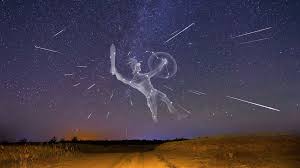
The big show in the sky tonight is the comet, Tsuchinshan-Atlas. It will be amazing about an hour after sundown, looking West. But there is another pretty cool sight to see.
The Orionid Meteor Shower.
Don't be afraid. The term "meteor shower" might give you the idea of a light shower... OF FIRE AND DESRTRUCTION FROM THE SKY! Relax. You're 99.99999% safe from meteors.
The Orionids radiate from a point near the upraised club of the constellation Orion the Hunter. The bright star near the radiant point is the reddish Betelgeuse. You might catch an Orionid meteor any time between about September 26 to November 22. From a dark location you might see 10 to 20 Orionids per hour at their peak. There’s always the element of uncertainty and possible surprise when it comes to meteor showers, though. These fast-moving meteors occasionally leave persistent trains or trails. The Orionids also sometimes produce bright fireballs or break up into fragments creating spectacular displays.
In 2024, the Orionid meteor shower should rain down its greatest number of meteors on the mornings of October 20 and 21. The morning of October 21 might bring the richest display of meteors. However, the waning gibbous moon will interfere with the meteor shower. Bummer. Also: clouds will really screw it up.
So, what exactly are meteors and where do they come from?
The Orionid meteors that we observe are actually fragments and bits of ice and/or debris that have been broken off of the most famous comet in history. That comet is, of course, Halley’s Comet. This comet orbits the sun every 76 years or so, and we intercept this path in late October each year. The official name for Halley’s Comet is 1P/Halley. It was the first comet to have its return predicted, and Edmond Halley was the one who made that calculation. The comet typically gets bright enough to be easily visible with recorded observations since 240 CE. It is one of only a few comets named not after its discoverer but after the person who calculated its orbit. Unlike most solar system objects, Halley’s Comet orbits the sun in a retrograde orbit, going around the sun in the opposite direction than we do.
The Orionids are produced from Halley’s Comet’s particles on its inbound leg. They are moving in one direction, we are moving in nearly the opposite direction, and the combined speeds produce fast-moving meteors. But we also encounter its particles from its outbound leg when it’s leaving the inner solar system. We reach that point in early May. They produce the Eta Aquariids meteor shower. So this comet generates two meteor showers. BONUS!
There's an app for that!
For help tracking The Orionids, Halley's Comet or any other cosmic phenomenon, try downloading a free-to-download app called SKYSAFARI. It's an astronomy app for Android that helps users locate stars, constellations, planets, and other celestial objects in the night sky. It's got an augmented reality (AR) mode, which blends the real sky with a planetarium view showing over 120,000 stars, 222 star clusters, nebulae, and galaxies, plus all the major planets and moons in the solar system. Includes an eclipse viewing guide with expert advice and it is regularly updated to support the latest version of Android. This is the one I personally enjoy and use quite a bit. It's available in your Google Play Store.
For the PC, try STELLARIUM. Lots of pretty great interactive features including a realistic sky view, as seen from your current location and time. You can use your mouse or keyboard to navigate and interact with the sky. Stellarium can also place you at any point on the earth's surface on any date and time of day, staring up and out into deep space. Pretty freakin' cool! It's free-to-download at:
www.stellarium.org